


BEFORE WE START
Why We Say “Introduction,” and Never “Pitch”
Every number in this report is about an introduction: an email from Interview Valet to a podcast host proposing a specific guest for their show. The industry calls these pitches. We do not, and the difference is not cosmetic.
A pitch is an ask. It is written for the sender, it leads with what the guest wants, and it treats the host as a gatekeeper to get past. Hosts have learned to ignore it.
An introduction is a service to the host. It starts from the host’s audience and asks one question: would these listeners be better off for having heard this person? If the answer is not clearly yes, the introduction does not get written. When it is yes, the email says who this is, why the two of you should talk, and gets out of the way.
The host is the customer in that email. Our client is the guest, but the host is the one who has to say yes, and the host’s listeners are the ones who have to keep listening. Write for them, and the yes takes care of itself.
That mindset shapes three things you will see in this study:
The outcome we measure is an invitation, not an open, a click, or a reply. A host saying “yes, come on the show” is the only result that matters.
Every guest we introduce is a Certified Guest™: prepared, briefed, and vetted before the first email goes out. An introduction is a promise to the host that the guest will deliver.
Volume is not the goal. We would rather send one introduction a host is glad to receive than ten the host deletes. That is also why the numbers in this report are expressed as comparisons, not raw counts: the question is never “how many did we send,” it is “when does a host say yes.”
ABOUT THIS SERIES
Podcast Interviews: Decisions Based on Data
This series takes questions that guests, hosts, and marketers usually answer with folklore and answers them with Interview Valet’s own operating data instead. Each report tests one question, shows the evidence, and ends with what to do about it.
THE SHORT ANSWER
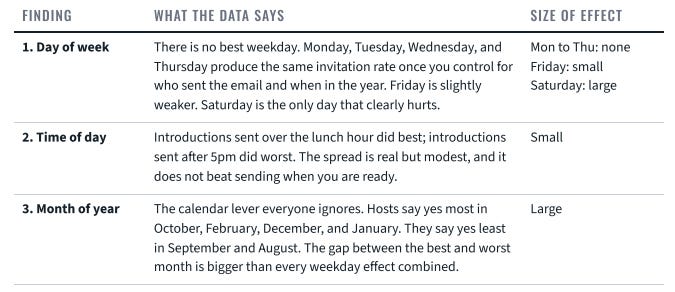
Day of the week barely matters. Time of year matters a lot.
We tested every introduction Interview Valet sent to a podcast host from October 2023 through September 2026 and asked one question: did the timing of the send change the odds that the host invited the guest?
4 DAYS
Monday through Thursday are statistically identical.
-44%
Odds of a Yes when the introduction goes out on a Saturday
1.5x
October’s invitation rate compared with September’s
THREE FINDINGS
PLUS TWO ‘WEIRD’ FACTS
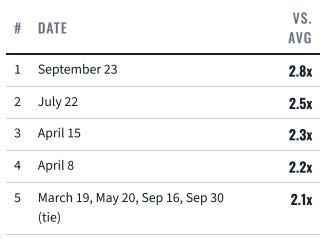
The single most productive date for invitations across three years was the Tuesday after Labor Day, which delivered nearly four times a typical business day’s worth of yeses.
September 30 is simultaneously one of the top days for invitations to arrive and the worst day of the year to send one.
All results are expressed as an index or a ratio against Interview Valet’s own average. Index 100 means “exactly average.” Raw invitation rates and counts are company confidential and are not disclosed.
FINDING 1
There Is No Best Day of The Week. There Is A Worst One.
Marketing lore says Tuesday morning. Our data says Tuesday is fine, and so are Monday, Wednesday, and Thursday. The chart shows the invitation rate for introductions sent on each day, indexed so the Monday-to-Friday average equals 100.

Index 100 = average invitation rate for introductions sent Monday through Friday. Grey text shows the share of all introductions sent on that day.
Tuesday’s 105 and Monday’s 100 look different. They are not. Controlling for the month of the send and for who sent it, and clustering by email (one email often introduces more than one guest), the four weekdays are within noise of each other. A statistical test cannot tell Monday, Wednesday, or Thursday apart from Tuesday.
WHAT DOES MOVE THE NEEDLE
Friday runs about 8% below the weekday average. The effect is small but it survived every robustness check we ran.
Saturday cuts the odds of a yes nearly in half (index 56). It is the one day the data says to avoid.
Sunday is weak (index 71) but the sample is small enough that we will not call it.
A WATCH ITEM
In the most recent twelve months alone, Tuesday pulled ahead of the other weekdays (index 121 against 95 to 100). Over the full three years it did not. One good year is not a rule, so we report the three-year answer and will revisit this next year.
Decision: Send Monday through Thursday, whichever day the introduction is ready. Do not hold a finished introduction for Tuesday. Do not send on Saturday.
FINDING 2
Lunch Beats Late Afternoon, But Not By Enough To Wait For
We also looked at the hour of the day the introduction left the inbox (US Eastern time). Introductions sent between noon and 1:00 pm had the best invitation rate; introductions sent after 5:00 pm had the worst.

Index 100 = Monday-to-Friday average. Grey text shows the share of all introductions sent in that window.
The spread from best to worst window is 17 index points. That is a real difference, but it is smaller than the Friday effect and far smaller than the seasonal effect on the next page. It is also partly a who-sends-when story: the relationship managers who send over lunch are not a random sample of the team.
Decision: If you are choosing between sending now and sending at 6:00 pm, send now. If you are choosing between 11:00 am and noon, it does not matter. Nobody should be scheduling introductions around the clock.
HOW FAST DOES A YES COME?
For introductions that do turn into an invitation, half of hosts reply within five days of the send and nearly two-thirds within a week. A quarter say yes within a day. The window for the first impression is short, which is one more reason the day of the week matters less than people think: a host who is going to say yes usually says it before the next weekend arrives.
FINDING 3
The Month You Send In Matters More Than The Day
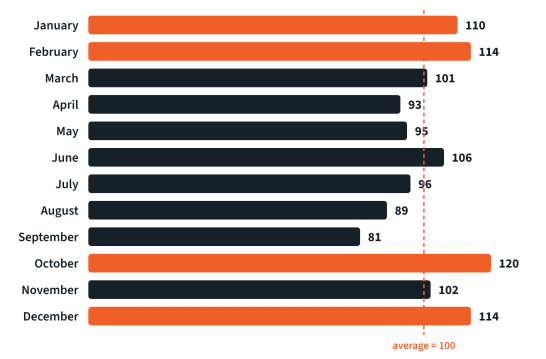
Index 100 is the average invitation rate across the whole year. October is the best month to introduce a guest to a host. September is the worst. The gap between them is 1.5 to 1.
BREAKDOWN BY QUARTER

WHAT THIS SAYS ABOUT HOSTS
Hosts book guests when they are planning, not when they are busy. Fourth quarter and first quarter are planning seasons: new year, new season, calendar gaps to fill. Late summer is when hosts are recording what they already booked, taking vacations, or batching episodes to get ahead.
The December result deserves a second look. The folk rule is that nothing gets booked in December. In our data, December sits with October and February among the strongest months. Hosts are filling January.
Decision: Front-load outreach into October through February. If a campaign has to launch in late summer, expect a lower yes rate and plan more introductions, not fewer.
WEIRD FACTS
The Five Best Calendar Days, Two Days
Two different questions hide inside “what is the best day.” One is the day hosts say yes. The other is the day an introduction goes out and later earns a yes. Here are both, pooled across the three years.
Days Hosts Say Yes
Invitations received on this calendar date, as a multiple of the average calendar date.
Invitations received on this calendar date, as a multiple of the average calendar date.
Days To Send
Invitations received on this calendar date, as a multiple of the average calendar date.

The worst send date of the year by the same measure: September 30, index 23. August 6 and September 1 round out the bottom three.
THREE ODDITIES WORTH REPEATING
The single biggest yes day in three years was Tuesday, September 2, 2025, the day after Labor Day. Hosts came back from the long weekend and cleared their inboxes: 3.8 times a typical business day’s invitations, spread across dozens of different guests and nearly every relationship manager.
September 30 shows up on both lists for opposite reasons. It is a top day for invitations to arrive and the worst day to send. Quarter-end: hosts are closing loops, not opening new ones.
Hosts say yes on Monday and Tuesday. Forty-four percent of all invitations arrive on those two days, against 14% on Friday and under 6% on the weekend. Whatever day you send, the answer tends to come early in the week.
DECISIONS
What To Do With This
If You Are A Guest (Or Booking One)
Stop optimizing the weekday. Spend that energy on fit and on the first sentence of the introduction.
Plan campaigns on the seasonal curve: heavy in Q4 and Q1, lighter and longer in Q3.
If you must launch in August or September, size the campaign up, not down.
Expect answers early in the week. A Friday send that has not been answered by Tuesday has probably been read.
Never send on a Saturday. If you finish on Saturday, schedule it for Monday.
If You Are A Host
You are not imagining it: your inbox fills with guest introductions in October and January because that is when you say yes.
If you batch guest decisions on Monday and Tuesday, you are in good company. Most hosts do.
Tell the people introducing guests to you when your booking windows open. The good ones will listen.
What We Changed At Interview Valet
Weekend sends are now a coaching item. Roughly one introduction in eleven was going out on a Saturday or Sunday. That is a free improvement.
Campaign pacing now leans into October through February, and late-summer campaigns carry an explicit volume adjustment.
We retired the “send on Tuesday” guidance. The evidence does not support it, and holding finished introductions for a particular day only slows the pipeline.
The one-line version: Send the introduction when it is ready, Monday through Thursday, and put your real effort into the time of year.
METHODOLOGY
How We Did It
DATA
Every first introduction Interview Valet sent to a podcast host between October 1, 2023 and September 30, 2026: more than 70,000 across roughly three years. Follow-up emails were excluded so each introduction is counted once, on its first send. The outcome is a recorded invitation from the host, regardless of how long it took to arrive or whether a follow-up was sent in between.
WHY WE USED THE REAL SEND TIMESTAMP
Our booking system records the date an introduction is created; our email system records the moment it is sent. The two agree only about two-thirds of the time, and nearly every introduction created on a weekend actually left the inbox on Monday or Tuesday. Using the creation date would have produced a false “weekends are terrible” headline. We matched each introduction to its send record and used that timestamp in US Eastern time. Roughly two-thirds of introductions could be matched; the rest were excluded from timing analysis.
CONTROLS
Time trend. The invitation rate has drifted over the three years as volume grew and the podcast landscape changed. All weekday and hour tests were run within a calendar month so a shift in mix could not masquerade as a weekday effect.
Sender. Each relationship manager has their own style and their own schedule. We controlled for sender so that “Saturday” does not just mean “the people who work Saturdays.”
Clustering. One email often introduces several guests to the same host, and one guest is often introduced to many hosts in a day. We clustered the statistical tests by email, and separately by guest campaign week, so those are not treated as independent trials.
Robustness. The weekday findings held when we used only same-day matches, excluded the highest-volume sender, and changed the clustering unit.
LIMITATIONS
This is observational data from one firm’s outreach. It describes what hosts did when introduced to vetted guests with a clear fit. It is not a controlled experiment, and it says nothing about cold pitches.
Introductions that could not be matched to a send record had a lower invitation rate than those that could, so absolute rates here describe logged sends. Comparisons between days and months should not be affected.
Calendar-day “weird facts” use a minimum-volume floor but remain noisy by nature. Enjoy them; do not plan around them.
Raw counts and rates are company confidential. All results are presented as indexes against our own average.
Decisions, Not Folklore.
Interview Valet has placed Certified Guests™ on podcasts since 2015 and coined the category of Podcast Interview Marketing. This series puts our operating data to work on the questions guests and hosts usually answer by guessing.

Coming Up
Next week we’re continuing our Common Sense Series.
Common Sense Facts That Are False #3: You Need A Book To Get Booked On Podcasts.

Tom Schwab is the founder and Chief Evangelist Officer of Interview Valet, the first and longest-running podcast interview marketing agency. He is the author of Podcast Guest Profits: Grow Your Business with the Targeted Interview Strategy and the recent mini-book Think Before You Talk: Stop Making Noise. Make Impact. A U.S. Navy veteran who ran nuclear power plants on aircraft carriers, Tom has spent his career insisting that decisions be made on instruments, not instincts. He lives in southwest Michigan with his wife Karen.
