


EXECUTIVE SUMMARY
What Hosts Are Telling The Guesting Industry
Podcast guesting has become a standard growth channel for authors, founders, and executives. But most of what gets written about “how to land a podcast interview” comes from the guest side. This study flips that lens.
We surveyed active podcast hosts about how they evaluate guest pitches, what frustrates them, and what they wish guests and the people pitching on their behalf understood. The results point to one consistent theme: fit matters more than fame, and follow-through matters more than the interview itself.
Three Findings Stand Out
Relevance beats everything. When ranking what makes a guest worth booking, hosts place audience fit and relevance well above social following, name recognition, or a “unique” angle. When asked what single red flag gets a pitch rejected immediately, 69% said the same thing: no clear connection to their audience or topic.
Reciprocity is the unspoken contract. Hosts described podcasting as an exchange, not a favor. The guest gets exposure; in return, hosts expect preparation and promotion. When that second half does not happen, it is the top complaint in the entire dataset, ahead of bad pitches.
The volume problem is real. 75% of hosts say they have personally experienced the flood of generic, mismatched pitches often called “guest pollution,” even though only about a quarter use that specific term. 63% report that a quarter or more of the pitches they receive are low-quality or clearly generic.
75% recognize the generic-pitch problem.
The label “guest pollution” is not universal. The experience is.
METHODOLOGY
How The Study Was Conducted
This study is based on a survey distributed to podcast hosts across a range of formats, audience sizes, and industries. The survey combined multiple-choice questions, a forced ranking exercise, and one open-ended question asking hosts to describe, in their own words, what they wish guests and the people pitching them understood.
Quotes used throughout this report are drawn directly from open-text responses and lightly edited for clarity and length. No identifying information was collected or is included.
01
What Hosts Are Actually Trying To Do
Before looking at guests, it helps to know what hosts are optimizing for. Asked for their #1 goal right now:
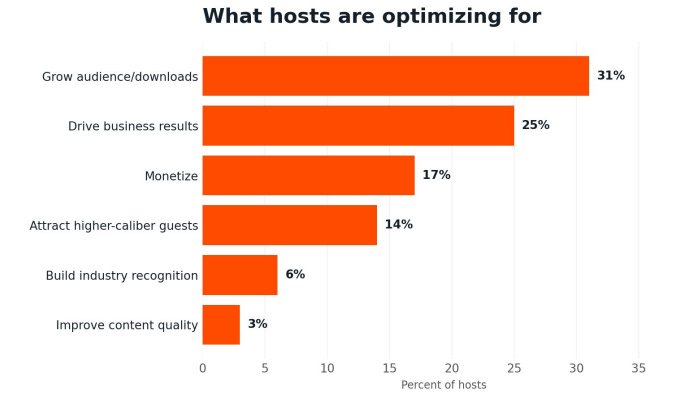
This matters for anyone pitching a guest: over half of hosts are optimizing for either audience growth or business outcomes, not prestige or novelty. A guest who can visibly move either number, through relevance to the audience or a willingness to promote, has a structural advantage over one who simply has an impressive title.
56% are primarily focused on audience growth or business results.
31% named audience/download growth and 25% named business results as their #1 goal.
02
How Hosts Actually Evaluate A Guest
We asked hosts to rank seven guest attributes from most to least important. A lower average score is more important.
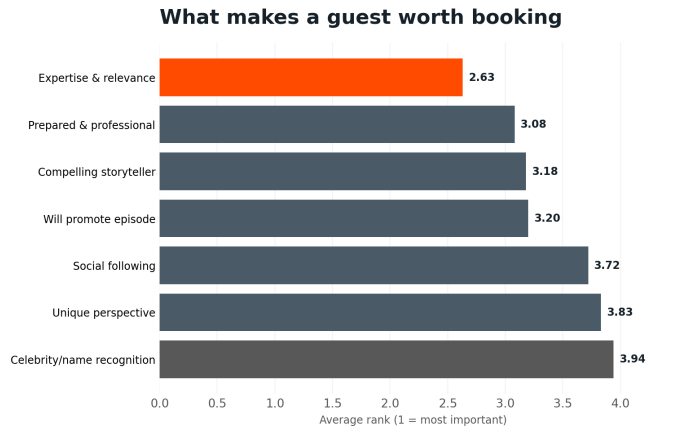
The gap is wide. Audience relevance ranked nearly a full point ahead of preparation, and more than a point ahead of celebrity factor. Social following and name recognition, the two attributes most often used as shorthand for a “good guest” in pitch decks, ranked last.
“A good podcast host has a mission for their show. The guest needs to fit into that mission. We all think our expertise is amazing, and it might be, but if it doesn’t fit the mission of the show, it won’t matter.”
ANONYMOUS PODCAST HOST
“Niche is most important. If you fit, or can clearly communicate how you fit my niche, you’re a more attractive guest.
ANONYMOUS PODCAST HOST
03
The Pitch Volume Problem
Hosts are fielding a real amount of inbound: 37% receive 3–5 pitches per week, 44% receive between 6 and 20, and 11% receive more than 20.
63% say at least one-quarter of inbound pitches are low-quality, irrelevant, or generic.
Nearly 1 in 5 say more than three-quarters of their pitches fit that description.
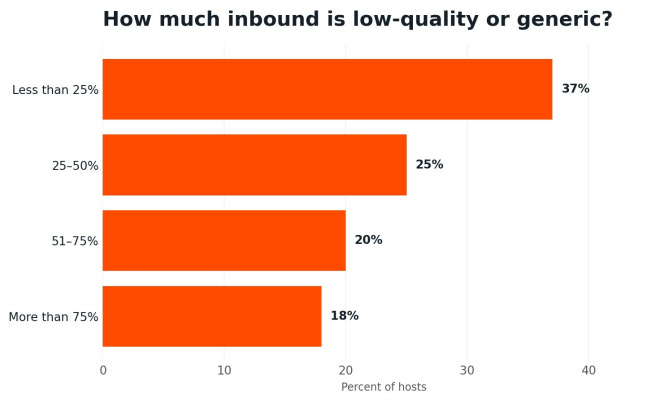
We also tested the term “guest pollution,” used informally in some podcasting circles to describe this flood. Reception was split, but the underlying experience was not: 49% experience the problem but would not use that specific term, while 26% said the term resonates and the problem is real. Roughly 75% recognize the underlying problem.
“We hear the same pitches all the time. No one is standing out anymore. It’s like we’re being sent robots.
ANONYMOUS PODCAST HOST
04
The One Red Flag That Ends A Pitch
We asked hosts for the single biggest reason they reject a pitch outright. One answer dominated:
69% said the guest has no clear connection to their audience or topic.
Everything else split into single digits.
This lines up directly with the ranking data above. Fit is not one factor among several. For most hosts, it is the whole filter.
“Too many guest pitches are about the guest and their audience, without any consideration for the host. The guest and their agent need to remember they’re pitching the host to be a guest on the show, not pitching their services to the host’s audience.”
ANONYMOUS PODCAST HOST
“Tell me immediately how what you have relates to my specific audience. There is so much good work out there. Sadly, much of what gets pitched is not my work.”
ANONYMOUS PODCAST HOST

05
What Actually Makes A Guest Appearance A Win
After a guest appears, hosts told us what matters most to them. They could select up to two responses.
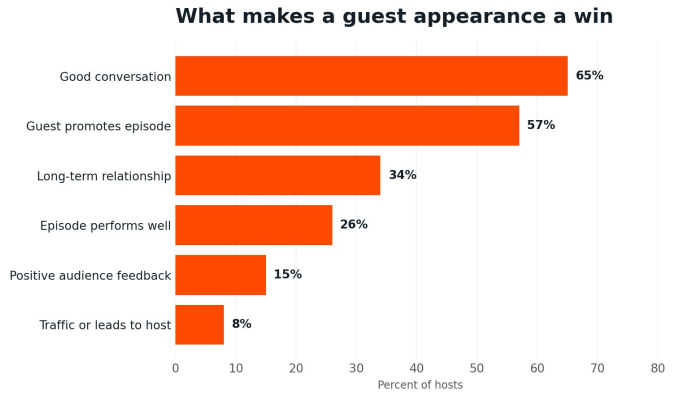
57% say active guest promotion makes an appearance worthwhile
Promotion ranks second only to the quality of the conversation itself (65%).
Promotion is not a nice-to-have. It is the second most-cited factor in what makes a guest appearance worthwhile, just behind the quality of the conversation itself, and it comes up constantly in the open-text responses as the single biggest source of frustration.
“I put effort into publishing the episode, posting to LinkedIn, and sending a summary email to my list. Every guest says they’ll share with their audience. About half will comment on my LinkedIn post. I rarely see a guest post independently about the episode.”
ANONYMOUS PODCAST HOST
06
What Hosts Would Change About The Industry
Asked what single change they would make to how podcast guesting works:
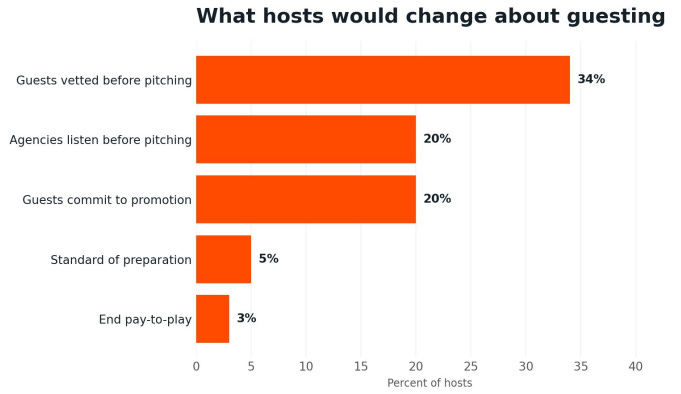
Vetting and fit again lead the list, followed closely by two versions of the same complaint: agencies pitching without doing the homework, and guests treating the interview as the finish line instead of the starting point.

“Agencies need to pick the show that is best aligned with the guest, not throw everything against the wall to see what sticks.”
ANONYMOUS PODCAST HOST
07
What Hosts Wish Guests Understood
The open-text responses were the hosts’ most consistent part of the entire survey. Three themes recur far more than any others.
a. Hosting Is Real, Ongoing Labor and Most Guests Don’t See It.
“It’s a lot of effort to create a good show. Pre- and post-production, promotion, editing, images, SEO-friendly titles and show notes, uploading to multiple platforms, sending reminders, getting guests to collaborate. All a guest has to do is show up prepared with unique content and help promote when it airs.”
ANONYMOUS PODCAST HOST
“The entire process on my end is a great deal of work: searching for guests, investigating their expertise, coordinating a date, sending prep info, securing bios and headshots, recording, editing, distribution, social media, and following up. So when someone is difficult to work with, doesn’t show up, or shows up late expecting me to be waiting, it’s very annoying and a huge waste of time.”
ANONYMOUS PODCAST HOST
b. It’s a relationship and a trade, not a stage.
“I wish brands, authors, and potential guests understood that podcasting is a relationship, not just another promotional stop. The best pitches show that you understand my show and can bring genuine value to the people listening, not simply something you want to sell.”
ANONYMOUS PODCAST HOST
“The host is giving the guest exposure. If the guest won’t reciprocate by sharing their appearance, they shouldn’t bother guesting.”
ANONYMOUS PODCAST HOST
c. “No” Is A Fit Decision, Not A Personal One.
“I wish people understood that “no” isn’t personal. It’s protection. I have to guard the voice of the show and the trust of the audience, so not every guest, no matter how good, is the right fit.”
ANONYMOUS PODCAST HOST
08
What This Means For Anyone Pitching A Podcast Guest
Taken together, the data points to a fairly clear playbook:
a. Lead with fit, not credentials.
Hosts ranked audience relevance above every other factor, and 69% name poor fit as their number one reason for an instant no. A pitch that opens with “here’s why this guest matters to your specific audience” will outperform one that opens with a bio.
b. Keep it short.
Multiple hosts described a near-instant yes/no decision window. Pitches that require real effort to parse are more likely to get deleted than declined.
c. Promotion is not optional.
It is the second most-cited factor in what makes a guest appearance worthwhile, and its absence is the most repeated complaint in the open-text data. A guest or agency that follows through on promotion stands out simply by doing what most don’t.
d. Personalize or expect to be ignored.
“Clearly a copy-paste template” and “no evidence the agency listened to the show” both appear repeatedly as disqualifiers, independent of how strong the guest’s actual expertise is.
FIT FIRST. PREPARE WELL. FOLLOW THROUGH.
That is what hosts are asking the guesting industry to do differently.
All quotes are anonymized and lightly edited for length and clarity.

Jessica Morgan, Chief Operating Officer of Interview Valet
Let’s Talk About This Report
Chat or talk with Tom Schwab’s AI.
Tom trained a bot on his thinking, frameworks, and research. Ask it anything about our reports, your own rubric, or Podcast Interview Marketing.
Work with an agency that runs the math.
If you want podcast introductions chosen on data and audience fit instead of opinion, book a discovery call.
