Everyone Has an Opinion About Reschedules. We Have the Data.
Ask ten people in podcasting how often interviews get rescheduled, and you will get ten confident answers. Guests swear hosts are flaky. Hosts swear guests go dark. Agencies warn clients to expect it. Everyone agrees it happens “all the time,” and nobody has counted.
ABOUT THIS SERIES
Podcast Interviews: Decisions Based On Data
This series exists to replace that kind of opinion with a number. For eleven years, Interview Valet has scheduled podcast interviews for clients one host at a time, and our team records what happens to every one of them. That is a dataset nobody else has, and it can answer the question directly: once a podcast interview has a date on the calendar, how often does that date move, who moves it, and how many times?
One in nine. 11.5% of scheduled interviews are rescheduled at least once. The other 88% happen on the first date set.
How We Ran the Study
We took every interview Interview Valet booked for a client over the two years from October 2024 through September 2026 that reached a scheduled date on the calendar. For each one, we asked three things: did the date move after it was set, who asked for the move, and how many times did it move. Interviews that were cancelled outright or no-showed are a different question and are held for a future report; this one is about dates that moved.
A reschedule was counted when either of two signals was present: our team’s “Reschedule” flag on the record, or a dated note from the team describing the move. The notes are where “who” and “how many times” come from. Every count was read from the record, then a sample was checked by hand before anything was published. Methodology and limitations are at the back.
Because this is our own operating data, the report uses percentages and ratios only, never raw counts.

BEFORE WE START
Why We Say “Introduction,” Not “Pitch”
Every report in this series starts with the same note. Interview Valet does not pitch hosts. We introduce a guest to a host the way a mutual friend would: here is who this person is, here is why your listeners would want to hear them, here is how to reach them. A pitch asks for something. An introduction offers something. The data in this series is the record of what happens after those introductions, including, in this report, what happens once the host says yes and a date goes on the calendar.
Finding #1
Nine Out of Ten Interviews Happen on the First Date Set.
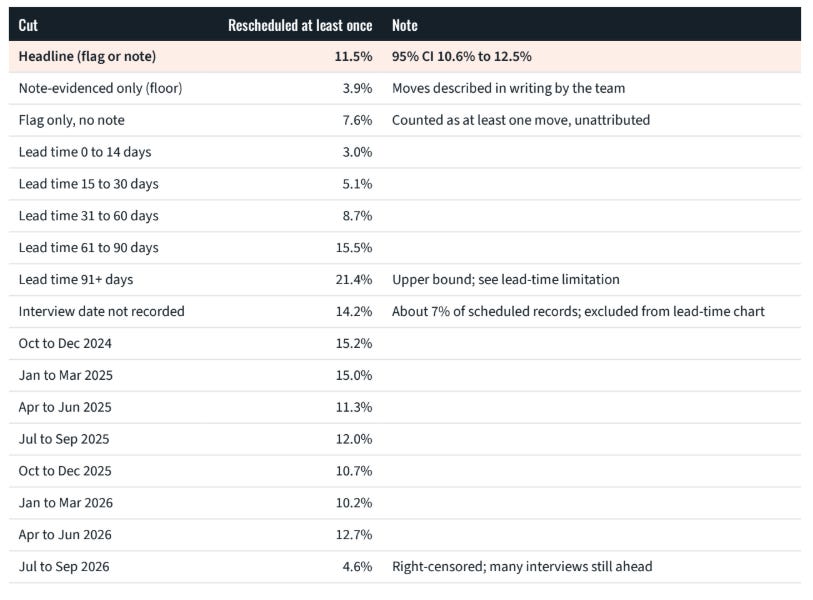
Across two years of scheduled interviews, 11.5% were rescheduled at least once (95% confidence interval 10.6% to 12.5%). The rest, 88.5%, were recorded on the date that was first put on the calendar. Among interviews that have since been recorded or published, 88.4% were recorded on their original date.
Of Every 100 Interviews, 11.5% Rescheduled At Least Once.

Every scheduled interview from October 2024 through September 2026. A reschedule is counted when the team flagged the record or a note describes the date moving.
“All the time” is one in nine. If you book nine podcast interviews, expect one of them to move. The other eight will happen when you first agreed they would.
The floor is lower, not higher. Counting only the reschedules described in writing by the team, the rate is 3.9%. The flag catches moves the notes do not mention, which is why the headline combines both. The true number is somewhere between 4% and 12%, and the evidence points to the top of that range.
A reschedule is a delay, not a loss. Rescheduled interviews still get recorded. 86% of them reached recorded or published status, against 89% of interviews that never moved. The three-point gap is the cost of a move.
Finding #2
When It Moves, It Moves Once.
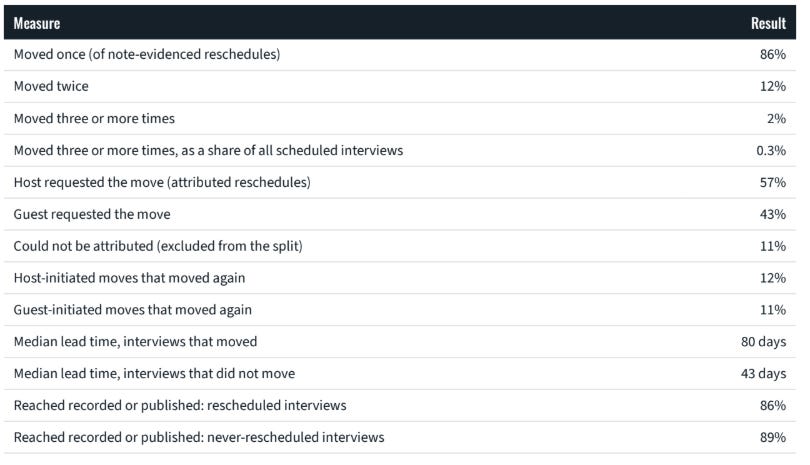
The fear behind “reschedule” is the endless one: a host who pushes three times and then goes quiet. The data says that host is rare. Of interviews that were rescheduled with the move described in the notes, 86% moved exactly once. Twelve percent moved twice. Fewer than one in forty moved three or more times.
When An Interview Moves, How Many Times Does It Move?
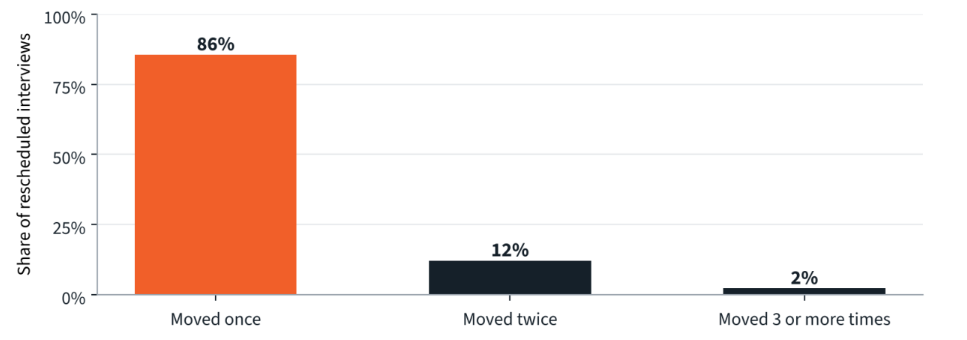
Interviews rescheduled at least once, October 2024 to September 2026, where the team’s notes describe the move(s). Counts are “at least”; a move the notes did not record is not counted.
The serial rescheduler is a story, not a pattern. Across the whole two-year window, interviews that moved three or more times are about 0.3% of everything scheduled. One in three hundred.
Hosts and guests are equally “once and done.” When the host moved it, 12% moved it again. When the guest moved it, 11% did. Neither side is the chronic one.
Finding #3
Hosts and Guests Move Interviews About Equally.
“Flaky hosts” is the most repeated opinion in the business. Among reschedules where the notes say who asked for the move, hosts asked 57% of the time and guests 43%. That is a lean toward hosts, but it is not a statistically reliable one (p = 0.09); a 50/50 split is well within what this sample could produce. Call it even.
Who Asked To Move The Interview?

Reschedules where the team’s notes in our database identify who requested the move; about one in nine reschedules could not be attributed and are excluded.
Guests, look in the mirror. Four in ten moves come from the guest’s side. Every guest who complains about host reliability is, statistically, nearly as likely to be the reason the date moved.
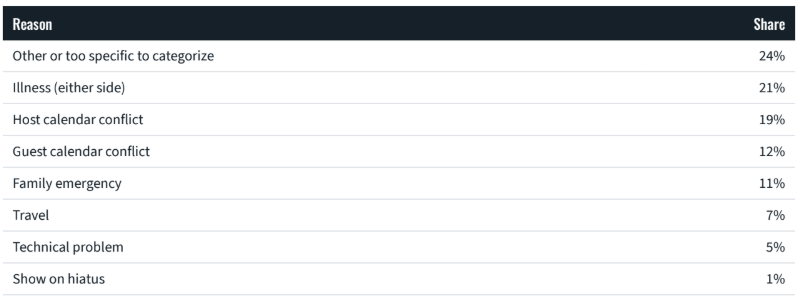
Life, not disrespect. Where a reason was recorded, the top three were illness (21%), a host calendar conflict (19%), and a family emergency (11%). Guest calendar conflicts were 12%. Travel and technical problems were small. Half of all reschedules had no reason written down, which is itself telling: a one-line “needs to move it” and a new date is the normal case.
Why Interviews Move
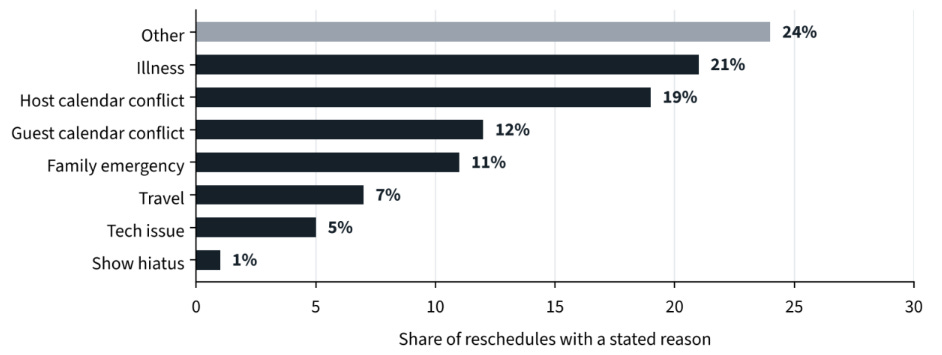
Reschedules where the notes state a reason (about half) in our database; “Other” includes a dropped host partner, a show restructuring, and reasons too specific to categorize.
Finding #4:
How Far Out You Booked Your Interview Is A Predictor of A Reschedule.
Nothing else in the data comes close. Interviews booked for a date inside two weeks were rescheduled 3% of the time. Interviews booked 91 or more days out were rescheduled 21% of the time. The curve rises in every step between, and the trend is statistically unambiguous (p < 0.000001).
Reschedule Rate by Lead Time
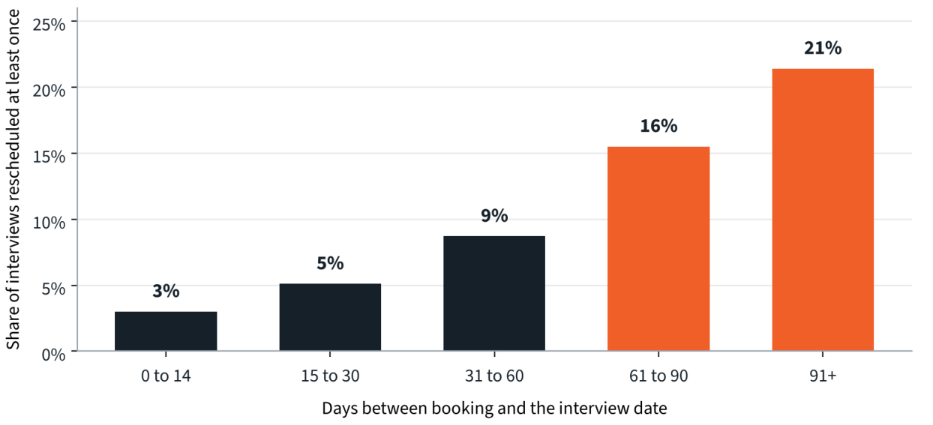
All scheduled interviews with a booking date and an interview date, October 2024 to September 2026. Days measured from the date the interview was booked to the final interview date. The median interview in the data is booked 47 days ahead.
Seven times the odds. An interview booked three months out is about seven times as likely to move as one booked within two weeks. Calendars decay. The further away a commitment sits, the more life has time to land on top of it.
The 60-day line. Under 60 days, fewer than one in ten interviews move. Over 60 days, it is one in six. If you have a choice of dates, the earlier one is the safer one.
One honest caveat. Lead time here is measured to the final date. When an interview moves, it usually moves later, which stretches its lead time. Some of the effect in the right-hand bars is the reschedule lengthening the gap, not the gap causing the reschedule. The direction of the finding survives that caveat; the exact size of the 91+ bar should be read as an upper bound.
Interviews that moved were booked a median of 80 days ahead. Interviews that did not move were booked a median of 43 days ahead.
Nearly double. If a host offers a date next week and a date next quarter, next week is not just sooner. It is more likely to happen at all.
What This Means for You
If you are a guest, stop bracing for chaos. Nine in ten of your interviews will happen when you agreed they would. Prepare for every one as if it is going to happen, because it is.
Take the earlier date. When a host offers options, the nearer one is 3 to 7 times less likely to move. Booking out “to give yourself time to prepare” is a trade: more preparation time for a higher chance of doing it twice.
When you have to move one, move it once. Hosts tolerate a single reschedule as routine. The data shows the second one is where interviews start to fall out of the normal pattern. Pick a date you can keep.
If you host, your guests are moving as often as you are. Before you add a “no reschedule” clause to your booking page, know that your own side of the ledger is 57% of the problem at most, and probably closer to half.
Build the reschedule into the plan, not the panic. For a campaign of 20 interviews, expect two to move. That is a calendar fact to schedule around, not a sign anything is wrong.
Questions to Ask Yourself
The last time an interview of yours moved, who actually asked for it?
How far out are you booking right now, and is that a preference or a habit?
If one in nine is the real number, what story were you telling yourself instead?
“Everyone has an opinion about reschedules. When you have the data, you can make decisions instead.”
Tom Schwab

Tom Schwab is the founder and Chief Evangelist Officer of Interview Valet, the first and longest-running podcast interview marketing agency. He is the author of Podcast Guest Profits: Grow Your Business with the Targeted Interview Strategy and the recent mini-book Think Before You Talk: Stop Making Noise. Make Impact. A U.S. Navy veteran who ran nuclear power plants on aircraft carriers, Tom has spent his career insisting that decisions be made on instruments, not instincts. He lives in southwest Michigan with his wife Karen.
Coming Up
Next week we continue the series Podcast Interviews: Decisions Based On Data
Does A Guest’s Job Title Change Their Acceptance Rate? Hint: It appears so, but not in the way you might think.
Let’s Talk About This Report
Chat or talk with Tom Schwab’s AI.
Tom trained a bot on his thinking, frameworks, and research. Ask it anything about our reports, your own rubric, or Podcast Interview Marketing.
Work With An Agency That Runs The Math.
If you want podcast introductions chosen on data and audience fit instead of opinion, book a discovery call.
Methodology
Source. Interview Valet’s internal campaign database: every client-podcast record booked between October 1, 2024 and September 30, 2026 (two years, by booking date) that reached a scheduled interview. “Reached a scheduled interview” means the record has an interview date, or its status is Scheduled, Recorded, Live, or one of the post-scheduling outcomes (host or client cancelled, host or client no-show, never went live, dates did not work). Pre-interview walkthrough calls and records that never got past the invitation are excluded.
Reschedule, headline. An interview counts as rescheduled when either (a) the team applied the “Reschedule” status flag to the record, which persists after the interview is rebooked, or (b) a dated team note on the record describes the interview date being moved after it was set. The two signals overlap only partly; the headline rate is their union. Rate (b) alone is reported as the floor.
How many times, and who. Both come from the team’s free-text scheduling notes, read record by record with an AI classifier under a written rule set: count only moves of this interview’s recording date after a date had been set; do not count first-time scheduling back-and-forth, pre-call moves, policy language (”if a client needs to reschedule...”), or re-bookings on a different show; a move with no stated count is one move; when unsure, count zero. The initiator is the party the note says requested the move; records where the note does not say are reported as unattributed and excluded from the host/guest split. A random sample of 30 classified records was reviewed by hand by the author before publication. Records carrying the flag but with no note describing the move are counted as rescheduled at least once and unattributed.
Lead time. Days from the record’s booking date to its interview date. Because the interview date is the final one, a reschedule that pushes the date later lengthens the measured lead time. The lead-time finding should therefore be read as a strong association with a known upward bias in the longest bucket, not as a clean causal estimate. The original (pre-move) date is not retained in the database.
Statistics. Headline rate: Wilson-style normal approximation, 95% CI 10.6% to 12.5%. Lead-time trend: chi-square test of independence across the five buckets (p = 3 x 10-38) and a rank correlation of bucket order with reschedule outcome (rho = 0.20, p < 10-39). Host vs. guest: exact binomial test against 50/50 on attributed moves (p = 0.09, not significant).
Why relative numbers only. Interview counts, client counts, and booking volumes are company confidential. Every result is expressed as a percentage, ratio, or multiple.
Limitations
Under-counting is more likely than over-counting. A reschedule only appears if a team member flagged it or wrote it down. Moves handled entirely between host and guest without the team’s involvement are invisible. The headline is best read as “at least 11.5%.”
Flag usage drifts. The share of records carrying the “Reschedule” flag declines across the window while note-based mentions do not, which suggests the flag has been applied less consistently over time. This is the reason both signals are combined.
Recent quarters are right-censored. Interviews booked in the most recent quarter have had less time to be rescheduled. No quarterly trend is reported for that reason.
Initiator is read from prose. “Host needed to reschedule” is clear; “rescheduled, new date 3/14” is not. About one in nine reschedules could not be attributed and are left out of the host/guest split, which could shift it a few points in either direction.
One agency’s clients. These are B2B and health/wellness thought leaders introduced to hosts by a professional team that manages the scheduling. Reschedule rates for guests who reach out to hosts cold, or who manage their own calendars, may differ.
Appendix
Appendix A: Every Cut We Ran
All figures are shares of scheduled interviews unless noted. Oct 2024 to Sep 2026.
Rescheduled Interviews: Times Moved and Who Moved Them
Stated Reasons (Where a reason was recorded, about half of reschedules)