THE QUESTION
The Interview Nobody Talks About
Every podcast guest has one. A great conversation, a thank-you from the host, a promise that the episode will be out in a few weeks. Then nothing.
No cancellation email. No explanation. Just silence where an episode should be.
We call them ghost episodes. Because most guests only ever see their own, nobody knows how common they are.
We do. We pulled every client interview from the last 18 months of introductions that reached the recording stage, then checked which ones actually aired.

BEFORE WE START
Why We Say “Introductions,” Not “Pitches”
Every report in this series starts with the same note. Interview Valet doesn’t pitch hosts. We introduce a guest to a host the way a mutual friend would. That introduction is a promise to the host that the guest will deliver. This report is about the promise that runs the other way: that a recorded conversation becomes an episode.
Every result in this report is expressed as a percentage. Raw counts are confidential to our clients and our business.
FINDING #1
About 1 in 8 Recorded Interviews Never Airs
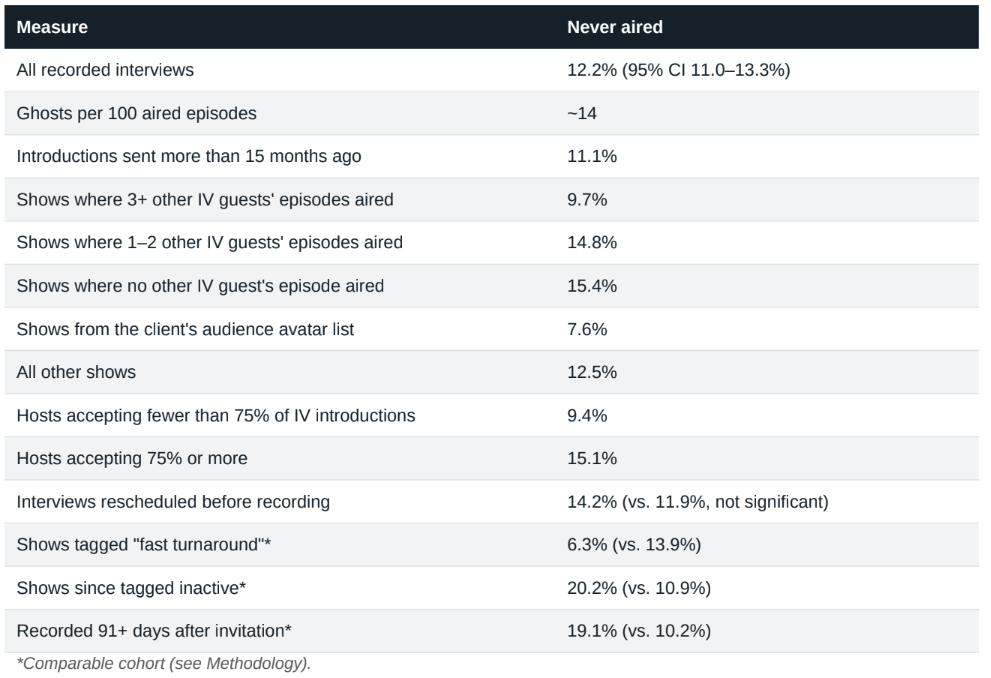
Of the recorded interviews in our data, 12.2% never went live (95% CI: 11.0% to 13.3%). Put another way, for every 100 episodes that aired, about 14 recorded interviews didn’t.

Source: Interview Valet database.
• This is after the hard part. These aren’t cancellations or no-shows. The guest prepared, showed up, and recorded.
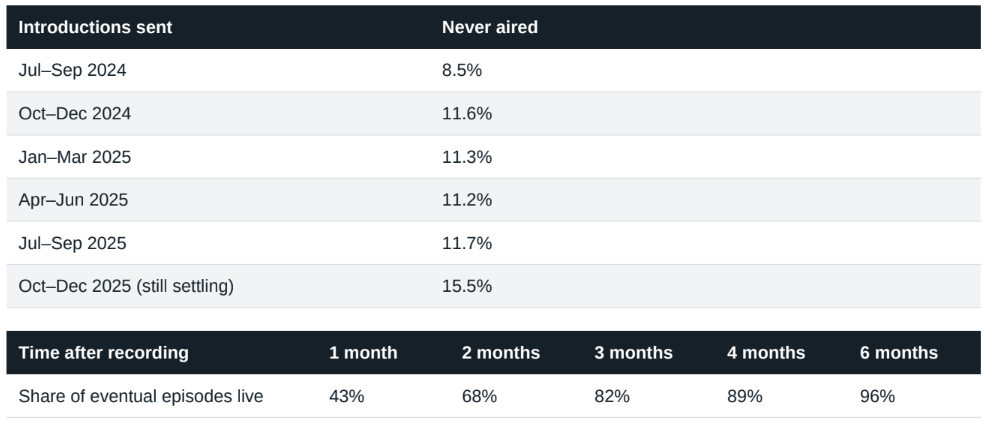
• The rate is steady. For introductions sent more than 15 months ago, where nearly everything that will air already has, the rate is 11.1%. Quarter by quarter it stays between about 9% and 12%.
• For a 20-interview campaign, expect two or three ghosts. That’s a planning number, not a failure.
Decision: Count an interview as a win when it’s live, not when it’s recorded.
FINDING #2
The Shows We Know Best Ghost the Least
The strongest pattern in the data is a show’s track record.
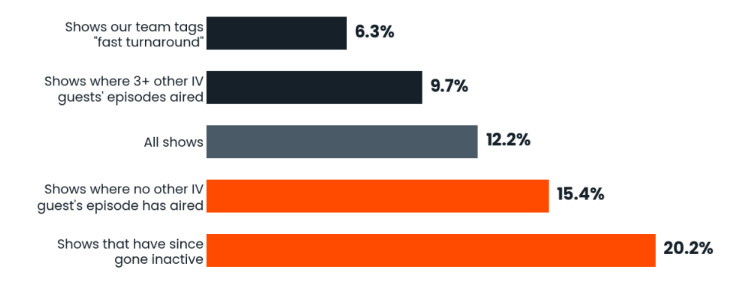
Share of recorded interviews that never aired, by show track record
The Shows We Know Best, Ghost The Least.
Source: Interview Valet database.
• Where three or more other Interview Valet guests’ episodes had already aired, only 9.7% ghosted. Where no other IV guest’s episode had aired, 15.4% did (p < 0.001). More than half of all the interviews in this study were with shows that have that kind of track record with us.
• It isn’t about volume. How many IV guests a show had recorded made no difference. How many of those episodes actually aired made all the difference.
• Ghosting clusters. Ghost episodes came from about one show in five. Half of them came from a small group of shows that ghosted two or more of our guests.
• Our team’s show notes confirm it. Shows we tag “fast turnaround” ghosted just 6.3% of the time. Shows that have since gone inactive ghosted 20.2%. But inactive shows account for only about a fifth of ghost episodes. Most ghost episodes happen at shows that are still publishing.
Decision: Before you record, find out how a show actually publishes, not just how big it is.
FINDING #3
Aligned, Selective Shows Publish What They Record
Two more patterns point the same way.
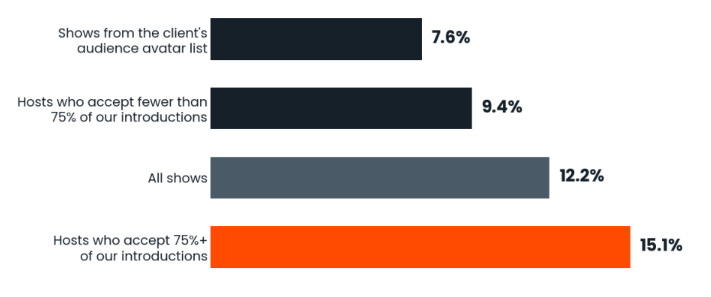
Share That Never Aired, By Fit and Selectivity
Aligned, Selective Shows Publish What They Record.
Source: Interview Valet database.
• Shows chosen from the client’s audience avatar list ghosted 7.6% of the time, against 12.5% for all other shows (p = 0.04). When a show is picked because its listeners are the client’s ideal buyers, the conversation is one the host wants to air.
• Hosts who say yes to almost everyone ghost more. Shows that accepted 75% or more of our introductions ghosted 15.1% of the time. Shows that accepted fewer ghosted 9.4% (p < 0.001). A host who is choosy about who comes on is also choosy about publishing who they chose.
• Long waits are a warning sign. In a comparable cohort, interviews recorded more than 90 days after the invitation ghosted 19.1% of the time, against 10.2% for 90 days or less.
One honest caveat. These are associations, not experiments. Avatar-list shows may differ in other ways too. But the direction is consistent across every measure: fit and selectivity go with episodes that air.
Decision: An easy yes isn’t the same as a good yes. Prioritize shows chosen for audience fit, and treat a host who accepts everyone with caution.
FINDING #4
By Six Months, You Know
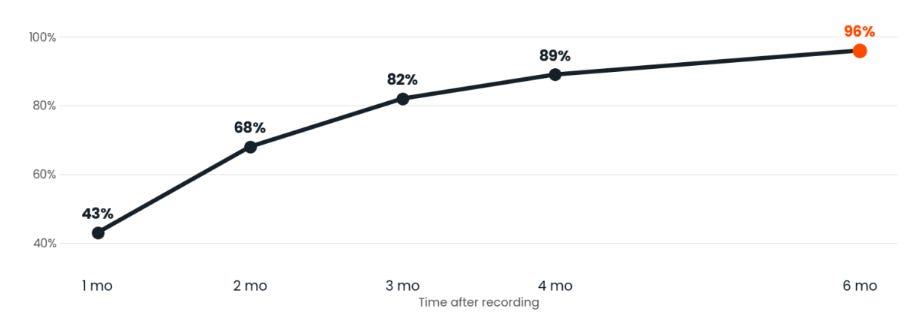
How long should you wait before calling an episode a ghost? Among episodes that eventually published, 89% were live within four months of recording, and 96% within six.
How Long To Wait Before You Know
By Month Six, 96% of Eventual Episodes Are Live.
Source: Interview Valet database.
• At four months, follow up. A friendly note asking for the release date is normal, and it’s often what moves an episode out of the queue.
• At six months, plan around it. An episode that isn’t live by then very likely won’t be.
Decision: Put a four-month follow-up on the calendar the day you record.
What It Didn’t Predict
Not everything we tested mattered. Interviews that had been rescheduled before recording didn’t ghost at a meaningfully higher rate (14.2% vs. 11.9%, not statistically significant). Neither did the number of IV guests a show had recorded. What predicted ghosting was how a show actually behaves: whether it publishes, how selective it is, and how well its audience fits the guest.
OUR APPROACH
How Interview Valet Hedges Against the 1 in 8
A ghost episode isn’t anyone’s fault in particular. Hosts get sick, change direction, and run out of time. But a 12% loss rate is too high to leave to chance. Here’s how we plan for it.
1. Quality and market message alignment come first.
Every interview should be one worth airing. A ghost episode costs the guest preparation time and an hour of their week, so we don’t spend that hour on shows that are merely available. We match each guest’s market message to shows whose audience actually needs it, and the data backs it up: shows chosen from the client’s audience avatar list ghosted 7.6% of the time, well under the average. Hosts who say yes to everyone ghosted more. Fewer, better-aligned interviews protect you from the episode that never airs.
2. We build and nurture ongoing relationships with hosts and shows.
This was the clearest finding in the study. Shows where our guests’ episodes had already aired ghosted far less than shows we were still getting to know. You only learn a show’s publishing habits by working with it over time, which is why our team records how every show publishes, flags the slow and inconsistent ones, and follows up when an episode stalls. Those relationships are also why a host answers our four-month follow-up. A database tells you a show exists. A relationship tells you whether it will air your episode.
3. We build bonuses into client campaigns.
Because about one recorded interview in eight will never air, we don’t make clients absorb that loss. Bonus interviews are built into our campaigns to buffer it, so a campaign still delivers the live episodes it was designed to deliver, even when a host goes quiet.
A recording is a promise. A live episode is a result. Plan for the difference.
DECISIONS
What This Means for You
• If you’re a guest, plan for one in eight. Build a buffer into any campaign, whether you run it yourself or hire someone.
• Ask how a show publishes before you record. How often? How long after recording? When did it last post? The answers predict more than download numbers do.
• Be wary of the easy yes. A host who accepts almost every guest is more likely to shelve the episode.
• Take the earlier recording date. Interviews recorded more than 90 days after the invitation ghosted nearly twice as often.
• Follow up at four months. Then plan around anything that isn’t live by six.
• If you host, a one-line email saves the relationship. “We’ve had to shelve this one” is far better than silence. Your guests will remember which one they got.
Questions to Ask Yourself
• How many of your recorded interviews are actually live right now?
• Do you know which of the shows on your list publish consistently?
• If one in eight of your next interviews never airs, does your plan still work?

Tiffany Meenk, Marketing Manager at Interview Valet
Let’s Talk About It
Chat or Talk with Tom Schwab’s AI.
You’re always one conversation away. Have one with the Tom-bot, my AI-trained clone with 11 years of my answers and none of my calendar constraints. Chat or talk about this study, the data, or podcast interview marketing in general.
Work With An Agency That Runs on Data, Not Folklore
Interview Valet is the category designer of Podcast Interview Marketing. For 11 years, we’ve matched category-designing B2B and health/wellness leaders with the podcast interviews that actually reach their ideal customers, selected on data like the data in this report, not on common sense myths that turn out to be false.
Coming Up
Next week we continue the series Podcast Interviews: Decisions Based on Data
How far ahead should an author start a podcast campaign for a book launch?
Methodology & Limitations
Source. Interview Valet’s internal campaign database.
Population. Every client interview from introductions sent over the last 18 months that reached the recording stage, with a current status of live, recorded, or never went live. Interviews span 247 client campaigns and more than 1,100 shows.
Ghost episode. A recorded interview that isn’t live: either marked “never went live” by our team, or still marked recorded. Some of the most recent “recorded” interviews may still air, so the headline rate is slightly high for recent quarters. For introductions sent more than 15 months ago, the rate is 11.1%.
Show track record. For each interview, the number of other Interview Valet guests whose episodes on the same show have aired.
Host selectivity. The share of Interview Valet’s introductions to that show that the host has accepted, all time.
Avatar list. Shows our team added from the client’s audience avatar list: shows chosen because their listeners match the client’s ideal customer.
Show notes and lead time. Tags our team maintains on each show (”fast turnaround,” “inactive”) and days from invitation to recording. These come from a comparable cohort of recorded interviews with the same statuses and introduction window, because those fields weren’t in the core data export. That cohort’s overall ghost rate was 12.0%, matching the main data.
How long to wait. Days from recording to live for episodes that published, from introductions sent October 2024 to September 2025.
Statistics. Headline: normal-approximation 95% CI. Comparisons: Fisher’s exact tests.
Why relative numbers only. Interview and client counts are confidential beyond the scale noted above. Every result is a percentage.
Limitations
• Status depends on our team’s tracking. If a host published without telling us and we didn’t catch it, the episode may be counted as a ghost. The true rate may be somewhat lower.
• Show notes are current, not historical. Some tags were added after the interview.
• Track record is measured within this data. A show’s history with Interview Valet before this window isn’t counted.
• Associations, not causes. Fit, selectivity, and track record travel together. This report shows they predict ghosting; it doesn’t isolate which one causes it.
• One agency’s clients. These are vetted guests on vetted shows. Self-scheduled guests on unvetted shows may see higher ghost rates.
Appendix A: Every Cut We Ran