

The Myth Came Home. So We Pointed the Instruments at Ourselves.
The first four reports in this series tested myths about the podcast charts: reviews, YouTube subscribers, social followings, Spotify followers. Each time the “common sense fact” explained almost nothing. This report turns the instruments around and points them at our own shop.
“You need a book to get booked on podcasts.” Every author believes it. Every non-author fears it. Hosts, the story goes, want a published expert, so a book is the price of admission. It sounds so obvious that most people never ask whether it is true.
Same two reactions as always. As a category designer, I reject the premise. As an engineer who ran nuclear power plants in the Navy, I want to see the data. And this time we did not have to borrow anyone’s data. For eleven years Interview Valet has introduced clients to podcast hosts one email at a time and recorded what every host said back. That is the cleanest dataset on this question that exists.
Authors get a yes 20% more often. Not twice as often. Not five times. Twenty percent.
How We Ran The Study
We took every introduction Interview Valet sent to a podcast host on behalf of a client over the twelve months from October 2025 through September 2026, and every host response to it. An introduction counts as a yes when the host invited the client onto the show. The yes rate is simply invitations divided by introductions sent.
Then we sorted every client campaign into two groups. Authors: clients with a published book, identified from their bio, their introduction copy, their topics, and whether a book summary was on file for hosts. Non-authors: everyone else. Clients with a book “in progress” but not yet published were counted as non-authors, because a host cannot be impressed by a book that does not exist yet. Forty-two percent of campaigns in the window were authors; fifty-eight percent were not.
We compared the two groups three ways: the pooled yes rate across all introductions, the yes rate campaign by campaign so one giant campaign cannot tip the scale, and the same comparison quarter by quarter to see whether the pattern holds or wobbles. Exact rates are proprietary to our clients and our business, so every result in this report is expressed as a ratio or an index, with the non-author group set to 100. The method and the robustness checks are in the methodology section and Appendix A. Check our work. That is the whole idea.
Finding #1: Authors Get a Yes 20% More Often. The Edge Is Real, and It Is Small.
Across twelve months of introductions, hosts said yes to authors 20% more often than to non-authors. Set the non-author yes rate at 100, and the author yes rate lands at 120. The 95% confidence interval runs from 112 to 129, and the difference is statistically unambiguous (p < 0.000001). The book helps. The data does not let us say otherwise.
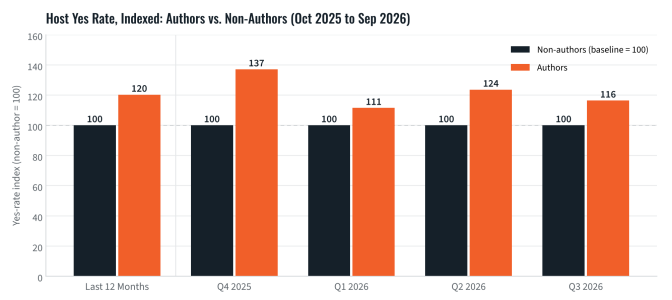
Each pair compares the author yes rate to the non-author yes rate in the same period. Non-authors are set to 100 in every period, so the orange bar reads directly as the author advantage.
The author advantage held in all four quarters: index 137, 111, 124, 116. It never flipped. It also never came close to the “you need a book” story, which would require something closer to 200 or 500.
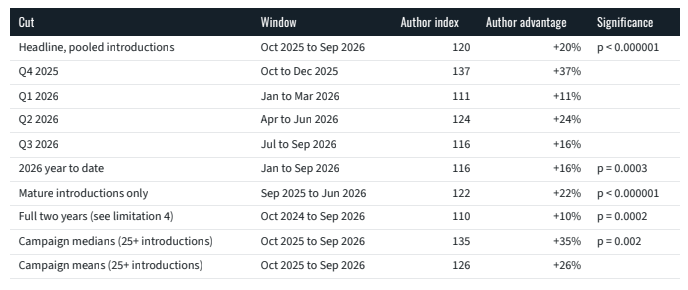
The full two-year view is even more modest. Widen the window to October 2024, and the author advantage shrinks to 10%. Year-to-date 2026 it is 16%. Restrict it to introductions old enough for every host to have replied, and it is 22%. Every window says the same thing: a real edge, in the teens or twenties, never a multiple.
Put it in host terms. For every five yeses a non-author earns, an author earns six. That is the entire difference a published book makes at the moment a host decides.
Finding #2: A Book Is a Nudge, Not a Gate.
Averages hide people. So we looked at every campaign with enough introductions to measure, one dot each, and indexed each campaign’s yes rate to the median non-author campaign. If a book were a requirement, the two rows below would barely touch. They do not just touch. They sit on top of each other.
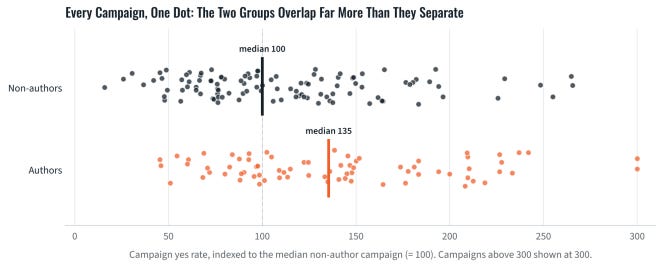
Each dot is one client campaign (Oct 2025 to Sep 2026, campaigns with at least 25 introductions). The vertical bar is each group’s median. Dots past 300 are plotted at 300.
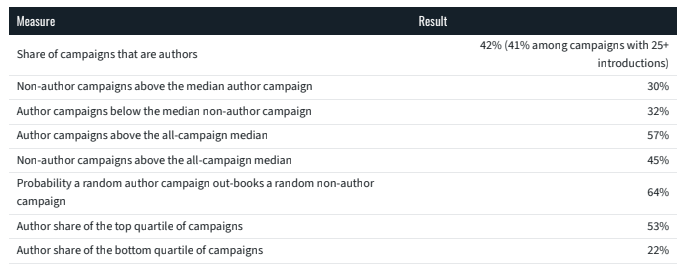
Thirty percent of non-author campaigns out-booked the median author campaign. No book. Better results than half the authors.
Thirty-two percent of author campaigns fell below the median non-author campaign. A published book, and a yes rate that most non-authors beat.
Pick one author campaign and one non-author campaign at random. The author wins 64% of the time. That is a coin that comes up heads a little more than it should. It is not a locked door.
The typical author campaign does run hotter: the median author campaign indexes at 135 against the median non-author campaign at 100. But the spread inside each group is several times wider than the gap between them; what a campaign is about, who it targets, and how it is introduced matter more than whether a book exists.
Finding #3: The Best Campaigns Are Not an Authors’ Club.
If a book were the key, the top of the leaderboard would be wall-to-wall authors. Here is who actually fills the top quarter and the bottom quarter of campaigns, ranked by yes rate.

Author share of all campaigns versus author share of the best and worst quartiles. A requirement would push the top bar toward 100% orange.
Authors are 41% of campaigns and 53% of the top quartile. Over-represented, yes. Dominant, no. Nearly half of the best-performing campaigns in the business belong to people who have never published a book.
Authors are 22% of the bottom quartile. A book cuts your odds of landing in the basement roughly in half. That is a meaningful benefit, and it is the kind of benefit a safety net provides, not a launchpad.
Fifty-eight percent of all the clients we introduce to hosts have no book. They get booked every week. The hosts who say yes to them did not get the memo that they were supposed to say no.
Why the Myth Feels True (and Why It Can’t Be)
Authors are more visible. They do launch tours, they get cited, they show up in the “about the guest” paragraph with a title in italics. So when you picture a podcast guest, you picture an author. That is availability bias, not evidence.
Here is the mechanism the myth ignores. A host is not booking a book. A host is booking thirty to sixty minutes of conversation that their specific audience will want to hear. The host’s question is “will this person be great for my listeners?” A book is one signal that answers it. A track record, a point of view, a clear audience match, and a well-written introduction are other signals, and most of them are stronger. A book moves the needle 20% because it is a credential. It does not move it 200% because it is not the thing being bought.
What This Means for You
If you don’t have a book, stop waiting for one. Nearly a third of non-author campaigns beat the typical author. The yes you are not getting is not because of the book you have not written. It is because of the audience you have not matched or the introduction you have not sharpened.
If you have a book, treat it as a 20% tailwind, not a guarantee. A third of author campaigns underperform the median non-author. The book opens the email. It does not carry the conversation.
If you are writing a book to get on podcasts, check your math. Twelve to eighteen months of writing to improve host yes rates by one-fifth is a poor trade if podcasts are the goal. Write the book because the book deserves to exist. Then use it.
If you host, notice what you actually say yes to. Our data says you book the fit, the story, and the audience match far more than the credential. Your own instincts are already smarter than the myth.
Measure the thing that decides. What hosts respond to is the clarity of why this guest, for this audience, right now. That can be engineered for anyone. A book cannot be back-dated.
Questions to Ask Yourself
When you last said yes to a guest, or booked one, was the book the reason, or the reassurance?
Can you name the audience a host would be serving by having you on? In one sentence?
If a book only moves the odds 20%, what moves the other 80%?
“Hosts don’t book a book. They book a conversation their audience will want. A book makes that 20% more likely. It doesn’t make it happen.”
Report finding, October 2026
Talk With Me About This Report
Chat or talk with my AI.
You’re always one conversation away. Have one with the Tom-bot, my AI-trained clone with 11 years of my answers and none of my calendar constraints. Chat or talk about this study, the data, or podcast interview marketing in general.
Work with an agency that runs on data, not folklore
Interview Valet is the category designer of Podcast Interview Marketing. For 11 years, we’ve matched category-designing B2B and health/wellness leaders with the podcast interviews that actually reach their ideal customers, selected on data like the data in this report, not on common sense myths that turn out to be false.

Tom Schwab is the founder and Chief Evangelist Officer of Interview Valet, the first and longest-running podcast interview marketing agency. He is the author of Podcast Guest Profits: Grow Your Business with the Targeted Interview Strategy and the recent mini-book Think Before You Talk: Stop Making Noise. Make An Impact. A U.S. Navy veteran who ran nuclear power plants on aircraft carriers, Tom has spent his career insisting that decisions be made on instruments, not instincts. He lives in southwest Michigan with his wife Karen.
Methodology & Limitations
Source. Interview Valet’s internal campaign database: every introduction sent by our team to a podcast host on behalf of a client, with the host’s response recorded against it. Introductions are dated by the day they were created. The headline window is October 1, 2025 through September 30, 2026.
Yes rate. Invitations divided by introductions sent. An introduction is a yes when the host invited the client to be a guest, regardless of whether the interview was later scheduled, recorded, or published. Introductions still awaiting a reply count as not-yet-yes, which depresses the most recent months equally for both groups.
Author classification. Each client was classified from four fields on file: expertise bio, host-facing introduction, topic list, and whether a book summary document was prepared for hosts. A client is an author when any field names a published book, a book title, a bestseller claim, an author credit, or a book summary exists. Clients described as writing or planning a book were classified as non-authors. Clients with no mention of a book in any field were classified as non-authors. Edge cases were reviewed by hand. Classification was done before any yes rates were computed.
Statistics. Pooled comparison: two-proportion z-test on the author and non-author yes rates (z = 5.0, p < 0.000001); relative lift reported with a 95% confidence interval on the ratio (+12% to +29%). Campaign-level comparison: campaigns with at least 25 introductions in the window; medians compared, Mann-Whitney U test (p = 0.002); the “author wins 64% of random pairings” figure is the Mann-Whitney probability of superiority. Quartile composition uses the same campaign set.
Why relative numbers only. Absolute yes rates, introduction counts, and invitation counts are confidential to our clients and our business. Every figure here is a ratio, an index with non-authors set to 100, or a percentage of campaigns. The conclusions do not depend on the absolute level.
Limitations. (1) This is one agency’s data. Our introductions are written by trained podcast relationship managers to shows our client account managers pre-approved for fit, so the baseline is higher and more consistent than cold outreach; the author edge could be larger in a cold-outreach world where a credential has to do more work. (2) Classification from on-file text can miss an author who never mentioned the book; that error pushes a few authors into the non-author group and, if anything, shrinks the measured gap. (3) No confounders were controlled. Authors may differ from non-authors in seniority, platform, or topic; this report measures the raw difference a host sees, not the causal effect of a book. (4) Twelve-month window. Records older than that are increasingly incomplete as unanswered introductions are retired, which inflates older yes rates; the two-year comparison in Appendix A is shown for transparency, not as the headline.
Reproducibility. Appendix A lists every window and every cut we ran, with the result of each, so the robustness of the finding can be judged without the raw data.
Appendix
Appendix A: Every Cut We Ran
Non-author yes rate is set to 100 in every row. “Author index” is the author yes rate on that scale. A value of 120 means authors got a yes 20% more often in that cut.
Campaign-Level Overlap (Oct 2025 to Sep 2026)
Classification Rules
Author signals counted: “author of”, “wrote the book”, “his/her/their book”, “bestselling” or “bestseller”, “book launch”, “book tour”, “book release”, “co-author”, a named book title, an Amazon book link, or a book summary document prepared for hosts. Signals excluded as false positives: “book a call”, “booking link”, “address book”, “favorite book”, and similar. Mentions of a book in progress, planned, or “working on” were classified as non-author. Mentions of a co-guest’s or third party’s books were classified as non-author.
