

Executive Summary
A prospective client recently handed us their rubric for acceptable podcasts. Twenty-seven criteria. Every single one sounds reasonable on its own. Together, they describe roughly five shows on Earth, and that is before asking whether the show covers the right topics for the right audience.
Most people call podcast targeting finding a needle in a haystack. A needle exists. A rubric like this one sends you into the haystack hunting for a mythical unicorn.
Here is what the math revealed:
1. The 10 quantitative criteria alone reduce 4 million podcasts to roughly 150 shows
2. The 15 subjective criteria reduce those 150 to approximately 5, and a third of those criteria cannot be verified with available data at any price
3. The only 2 criteria that predict actual results (audience fit and topic relevance) were an afterthought
4. The fix is not lower standards. It is knowing what factors actually drive results
5. Even the perfect list guarantees nothing. Selection sets the ceiling. The invitation, the interview performance, and the repurposing decide how close you get to it
The Common Sense “Fact” That Is FALSE
“The stricter your podcast rubric, the better your placements.”
It sounds like wisdom. Be selective. Protect the brand. Only accept the best. Nobody ever got fired for adding another criterion to the checklist.
As a category designer, I reject the premise. As an engineer who ran nuclear power plants for the Navy, I want to see the math. Nuclear operators live by a rule: every safety system you add also adds a failure mode. Requirements are not free. Each one costs you something, and the bill compounds.
So when this rubric landed on my desk, I swallowed hard… I laughed, then we ran the numbers (shout-out to Fable 5).
The Rubric, As Received
Shared here anonymized and lightly edited for clarity. This is a real rubric from a real prospective client, and if you have ever built a target list, I suspect parts of it will look familiar.
The Quantitative Ten
1. Has an active podcast (published in the last 30 days)
2. Is in English
3. Routinely has guests
4. Has published over 100 episodes
5. Has over 100 ratings and reviews on Apple Podcasts
6. Average Apple rating above 4.5 stars
7. Host has over 10,000 connections on LinkedIn
8. Host has over 10,000 followers on Instagram
9. Host has over 10,000 followers on X
10. Host has over 10,000 subscribers on YouTube
The Subjective Fifteen
11. Host has notable awards or mentions in the industry
12. No ads or sponsorships that conflict with my brand, company, or values
13. Notable high-profile past guests
14. Possibility for joint ventures or collaborations
15. Strong SEO practices for valuable backlinks and discoverability
16. Promotes each episode to all channels
17. Host controls or is part of a large organization with wide reach
18. Host has a substantial email list and promotes each episode
19. Has a loyal and engaged audience
20. Well-edited content that maintains listener engagement
21. High-quality video production that reflects professionalism
22. Host is known for insightful and respectful interviews
23. Host is well respected with a positive public image
24. Host has no history of controversial or hateful content
25. Host is not linked with lackluster organizations or individuals
And Finally, the Fit Criteria
A. The podcast audience consists of people within my target market
B. The podcast covers topics relevant to my expertise
Hold onto that lettering. We will come back to it.
Part 1: The Quantitative Funnel
Start with every registered podcast in the world and apply the ten measurable criteria in order. The estimates below are directional industry figures, and the sensitivity analysis at the end shows why precision does not change the conclusion.
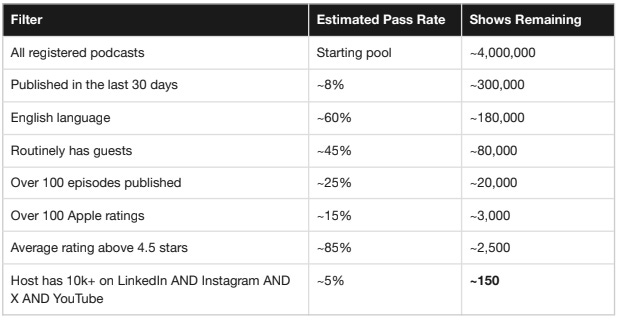
Two of these filters deserve a closer look.
The ratings filter is brutal, and nobody sees it coming. Most podcasts, including good ones with real audiences, have fewer than 50 Apple ratings. Our earlier research in this series studied 400 top-charting business and health shows and found that ratings volume does not predict chart position. Requiring 100+ ratings does not select for audience quality. It selects for show age and for hosts who ask for reviews.
The four-platform social requirement is the collapse point. Requiring 10,000 followers on any one platform is a meaningful bar. Requiring it on LinkedIn, Instagram, X, and YouTube simultaneously is a different universe, because audiences do not transfer. Business hosts are large on LinkedIn and invisible on Instagram. Lifestyle hosts are the reverse. The fraction of qualified hosts who clear all four bars at once is tiny, and it has nothing to do with whether their listeners buy what you sell.
Ten reasonable criteria in, and the entire planet holds about 150 qualifying shows. No topic filter has been applied yet. These 150 span true crime, parenting, crypto, comedy, and gardening.
Part 2: The Fifteen You Cannot Look Up
The quantitative criteria at least have answers. The next fifteen have a different problem. When we tried to design a verification method for each one, they sorted into three buckets.
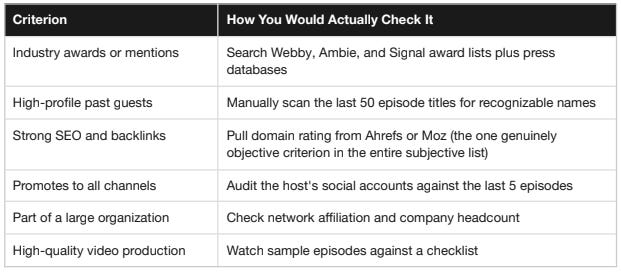
Bucket 1: Measurable, If You Pay For It
These six can be scored with proxies, at a real cost in research hours per show.
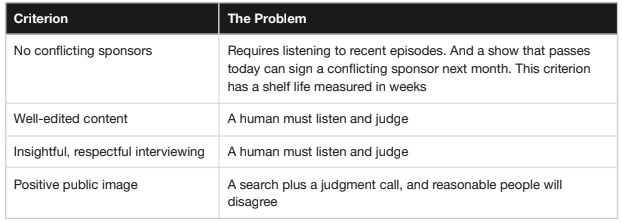
Bucket 2: Human Judgment, Expiring Constantly
These four require a person to consume the content and render an opinion. Worse, the answers expire.
Bucket 3: Unknowable In Advance
These five cannot be verified before the relationship exists, at any budget.
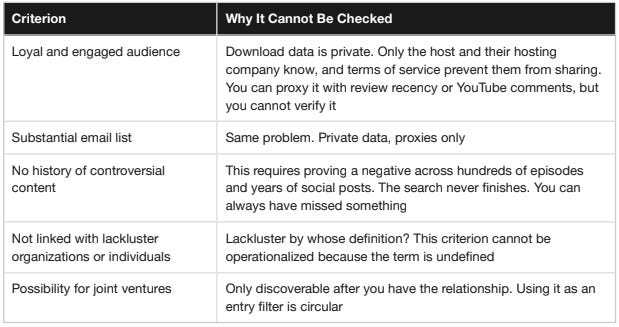
Here is the distinction that matters, and it is the heart of this report:
Several of these criteria are not strict. They are undefined. Those are not the same thing.
Strict means a high bar you can measure. Undefined means a bar that moves after you jump. A rubric full of undefined criteria does not protect your brand. It just guarantees that every decision gets relitigated later, because nobody can prove any show ever passed.
Part 3: Gates Multiply
Now the math that makes this a Common Sense Facts problem.
Every criterion used as a pass/fail gate multiplies against every other one. Suppose we are generous and assume each of the fifteen subjective criteria passes a high percentage of the 150 shows that survived the quantitative funnel:
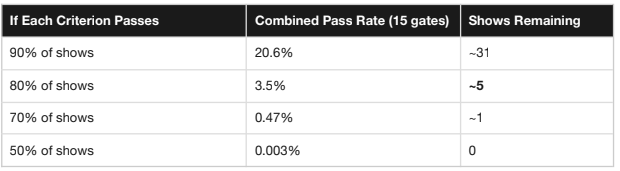
Read that middle row again. If every subjective criterion is easy enough that 4 out of 5 quality shows pass it, the rubric still leaves five podcasts on the planet. And criteria A and B, the topic and audience fit, have still not been applied. Apply them, and the expected number of qualifying shows is zero.
This is not a strictness problem. It is a structure problem. The client did not write a targeting rubric. They wrote a description of a podcast that does not exist, then asked how many introductions we could make to it.
Gates multiply. Scores rank. That one sentence is the entire fix, and it is where we go next.
Part 4: The Afterthought
Look back at the rubric. Twenty-five numbered criteria measure the host: their fame, their following, their reputation, their production values. Two lettered criteria measure the audience: whether the right people are listening and whether the conversation fits your expertise.
The two-lettered ones are the only two litmus tests that predict results.
This is not a guess. Earlier reports in this series studied 400 top-charting shows across two verticals and found that host fame metrics, including ratings volume and YouTube following, do not predict chart performance, let alone listener action. A show with 5,000 Apple ratings and a perfectly matched audience fails this rubric because the host has 8,000 Instagram followers. A show with a celebrity host and an audience that will never buy passes 25 of the 27 criteria.
The rubric optimizes for the host looking impressive in a screenshot. Results come from the audience taking action after the episode.
Part 5: What a Working Rubric Looks Like
The answer is not to lower your standards. It is to give each standard the right job. And if you have ever built a rubric like the one above, here is the honest read: your standards are not the problem. The structure is.
Step 1: Two gates. Only two.
• Gate A: The audience is your target market. The specific person who buys from you
• Gate B: The topics match your expertise. You can add value in this conversation
If a show fails either gate, nothing else about it matters. If it passes both, it goes on the list.
Step 2: Everything else becomes a score, never a gate.
Take the criteria that are measurable and weight them. This is what we have done for the industry in 2025 in conjunction with PodEngine on the Podcast Authority Score: an AI-powered benchmark that weighs hundreds of transparent, public data points to rank a show’s real-world authority within its category, instead of gating on any single vanity metric.
Step 3: Spend your verification budget on the gates.
Here is the irony of the original rubric. It spends enormous checking effort on criteria that do not predict results, while the two that do predict results are the hardest to verify. Confirming that a show’s audience genuinely matches your target market requires listening to episodes, studying who engages, knowing the host, and often having placed guests there before. That is the expensive, unglamorous work. It is the art of having access to all of the data and finding the needle in the haystack. This is also the only work that pays.
Full disclosure: that work is what Interview Valet has done for more than a decade, across 75,000+ interviews. We are not neutral on this question. But the math above is not ours to argue with. It is just multiplication.
Part 6: The Rubric Cannot Measure You
Fix the rubric, run the two gates, score the tiebreakers, and you will hold something rare: a genuine list of ideal shows. Now for the truth no rubric can capture. Finding the unicorn is only half the hunt. The right show is necessary for results. It is not sufficient.
Remember the lesson of Part 3: gates multiply. Downstream of selection, so does everything else. The return on a podcast interview is the product of four more factors, and a zero anywhere zeroes the whole equation.
1. The invitation. The best show on your list does not owe you a seat, and great hosts guard their audience fiercely. You earn the yes with positioning: a clear point of view the audience has not heard, proof you can carry a conversation, and a personal introduction instead of a mass email. Hosts can smell a form letter from the subject line.
2. The open and the close. Listeners decide in the first two minutes whether you are worth the next forty. Start with the transformation you deliver and the story that proves it, not a resume recital. Then the close: the last two minutes determine whether anything happens after the episode. One clear, specific next step beats a list of every social handle you own. An interview that opens flat and closes vague can sit on the perfect show and still produce nothing.
3. A magnet, not a megaphone. A megaphone talks at the audience about you. A magnet serves the audience so the right listeners pull themselves toward you. That means teaching generously on air, then giving listeners a dedicated welcome page built for them, not a generic homepage. Interviews used as megaphones create impressions. Interviews used as magnets create clients.
4. The refinery. An interview is a single asset. Repurposed, it becomes clips, articles, email content, social proof, and the very SEO and AEO backlinks the original rubric was chasing. The interview is the ore. Repurposing is the refinery. Guests who mine every conversation get multiples of the return of guests who merely record and move on.
Notice what happened. The original 27-point rubric spent all of its rigor measuring the podcast and none measuring the guest’s own readiness. Yet three of these four multipliers belong entirely to the guest. The most common reason a perfect placement produces nothing is not the show. It is a guest holding a megaphone.
Methodology and Assumptions
The funnel figures are directional estimates built from published industry data on podcast registration counts, activity rates, and ratings distributions, combined with our own operating data from vetting shows since 2014. They are reliable without being accurate to the decimal, and for this analysis, that is enough. Sensitivity check: cut every pass-rate estimate in half or double it, and the destination does not change. Twenty-seven stacked gates collapse any pool to a handful, because gates multiply. The conclusion survives every reasonable version of the inputs.
Talk With Me About This Report
Chat or talk with my AI.
I trained a bot on my thinking, my frameworks, and this research. Ask it anything about this report, your own rubric, or Podcast Interview Marketing.
Work with an agency that runs the math.
If you want podcast introductions chosen on data and audience fit instead of common sense myths, book a discovery call.
Tom Schwab is the founder of Interview Valet, the category designer of Podcast Interview Marketing, and the author of Podcast Guest Profits. A Navy veteran who ran nuclear power plants on aircraft carriers, he has an unreasonable insistence on seeing the data before believing the common sense.
